Pressure grows for employers to provide mandatory mental health first aid
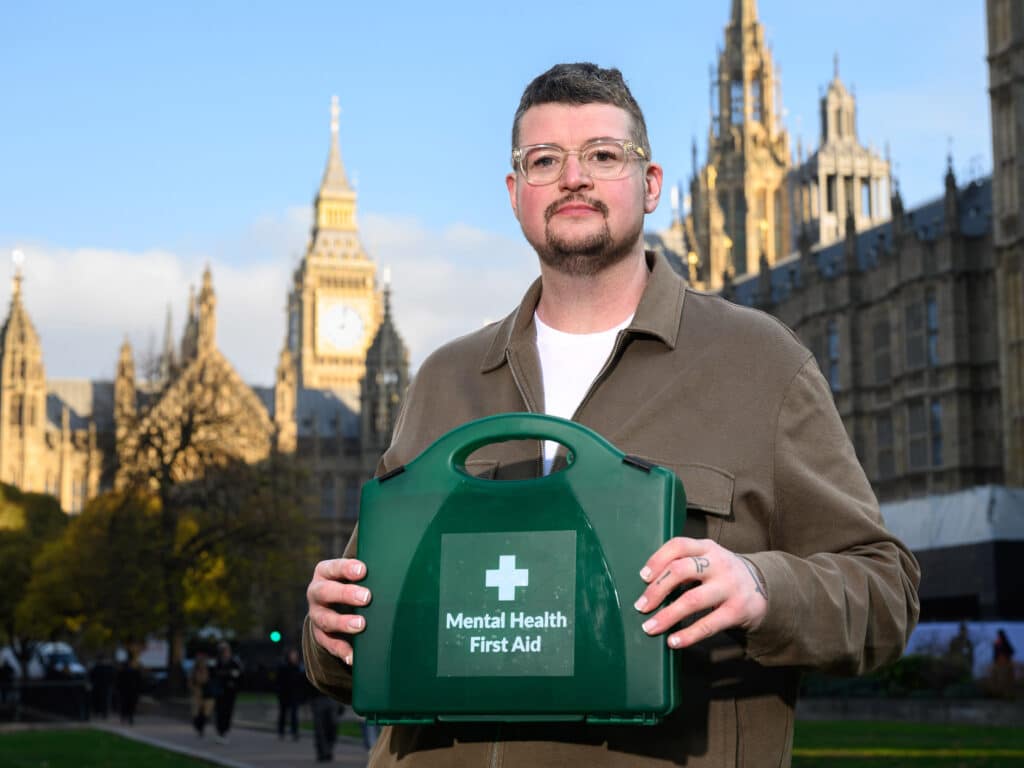
Mental Health First Aider John Junior gathers outside the Houses of Parliament in London alongside representatives from industries including aviation, performing arts, construction and manufacturing to call for mental health first aid to become a legal workplace requirement. Issue date: Wednesday November 18, 2026. PA Photo. Marking World Mental Health First Aid Day, the group is supporting a petition launched by campaigner John Junior and backed by MHFA England, calling for mental health first aid to be given the same importance as physical first aid in the workplace. Photo credit should read: Doug Peters/Assignments/Press Association
Three-quarters of UK workers support making mental health first aid a legal requirement in workplaces, as new research reveals that almost half would wait until breaking point before seeking help from their employer.
Mental Health First Aid England (MHFA England) is backing a campaign calling for mental health first aid to be recognised alongside physical first aid in workplace provision, amid concerns that stigma, fear of career consequences and inadequate access to support continue to prevent employees from speaking up.
The campaign, launched to coincide with World Mental Health First Aid Day on 18 November, brings together Mental Health First Aiders from sectors including aviation, construction, manufacturing and the performing arts.
New research commissioned by MHFA England, involving 3,000 UK employees, found that 76 per cent support a legal requirement for employers to include mental health first aid in their workplace provision, with just four per cent opposed.
More than half (53 per cent) said they had hidden mental health difficulties from colleagues, while 52 per cent worried that discussing their mental health at work could damage their promotion prospects. A further 57 per cent felt pressure to appear well even when struggling.
The findings expose a persistent gap between the availability of workplace mental health support and employees’ confidence in using it.
While 83 per cent of workers knew where to seek help for a physical injury at work, just 60 per cent knew where to access mental health support.
The campaign is being spearheaded by Mental Health First Aider and advocate John Junior, whose parliamentary petition calls for employers to be legally required to include mental health first aid within their existing first-aid arrangements.
The proposed change would give employees access to someone trained to recognise signs of poor mental health, initiate supportive conversations, provide initial assistance and direct colleagues towards appropriate professional support.
Mental Health First Aider and campaigner John Junior said: “I started this petition because I believe mental health support should receive the same recognition as physical first aid in the workplace. We wouldn’t think twice about offering a colleague a plaster for a cut, so why should an invisible wound be any different?”
The case for earlier intervention
The findings come as employers face growing scrutiny over how effectively they prevent mental health problems from escalating into long-term sickness absence or employees leaving work altogether.
Research commissioned by MHFA England found that 28 per cent of respondents said inadequate mental health support had contributed to their decision to leave a job in the previous two years.
Among employees with access to a Mental Health First Aider, 43 per cent said that access was one reason they had remained with their employer.
Those with access to a Mental Health First Aider were also more likely to feel comfortable discussing their mental health at work, at 55 per cent compared with 32 per cent among those without access.
Similarly, 67 per cent felt their employer cared about their mental wellbeing, compared with 40 per cent of employees without access to a Mental Health First Aider.
Although these findings show an association rather than proving that mental health first aid directly improves retention or workplace culture, they suggest that accessible, visible support may help employees feel more confident seeking assistance.
Sarah McIntosh, Chief Executive of MHFA England, said: “When more than one in four say inadequate mental health support contributed to them leaving a job in the past two years, employers cannot afford to wait. Support must start earlier: with manageable workloads, managers who listen, and somewhere to turn when things get difficult.
“Mental health first aid is one part of that approach, providing staff with access to a trained colleague who can help them take the first step towards support before difficulties escalate. That’s why we’re backing this petition.
“Helping people stay well and stay in work is good for them and good for business. Our Workplace Mental Health First Aid Standards show employers how to support MHFAiders properly, while our Association provides 120,000 members with ongoing learning, resources, and peer connections.
“No one should have to leave a job they love because they couldn’t find the support they needed. It’s time to mandate mental health first aid in the workplace.”
From training to workplace standards
The renewed campaign follows the launch of MHFA England’s Workplace Mental Health First Aid Standards in October, which set out nine principles for effective workplace provision.
These include ensuring Mental Health First Aiders have protected time to fulfil their responsibilities and appointing a named lead to oversee provision. Nearly 150 organisations have pledged to support the standards.
The Well Crowd attended a parliamentary event at the House of Commons last week (12 November), where the importance of workplace mental health support and the role of Mental Health First Aiders were discussed.
A legal requirement for mental health first aid would represent a significant development in workplace health provision, but would not, on its own, address the working conditions that contribute to poor mental health.
The challenge for employers is ensuring that trained Mental Health First Aiders are properly supported, employees know how to access help and concerns raised through workplace support arrangements lead to appropriate action.
The parliamentary petition is calling for mental health first aid to become a legal requirement. No such change has yet been enacted.
The research was conducted by 3Gem Research and Insights among 3,000 employed UK adults between 4 and 10 November 2026.
Further information: Parliamentary petition calling for mandatory workplace mental health first aid.
Related News
-
 Opinion & Commentary
Workforce Technology & Insights
How to tackle Technostress and growing AI anxiety
1 December 2025 6 min readAll Sectors -
 Industry News
Leadership, Culture & Development
moneyappi founder takes advisory role at workplace wellbeing group
16 June 2026 2 min readFinancial, Legal & Professional -
 Industry News
Mental Health & Emotional Wellbeing
Four in 10 Mental Health First Aiders have supported a colleague experiencing suicidal thoughts
10 September 2026 4 min readAll Sectors -
 Industry News
Mental Health & Emotional Wellbeing
UK employers “wasting wellbeing spend” as almost half of workers ignore their benefits
19 August 2026 3 min readAll Sectors