Understanding trauma addiction and recovery

By Natasha Trafford-Chant, Registered Mental Health Nurse and Director of Wild Rose Therapy
People do not usually begin drinking or using drugs with the intention of becoming addicted. The beginning may be ordinary: a drink to feel more confident, relax around other people or quiet a mind that will not settle. For some people who have experienced trauma, alcohol or drugs become a way of managing feelings that are difficult to bear. They may soften shame, ease loneliness, numb pain or offer temporary relief from overwhelm.
Recognising that relief matters. Something can serve a purpose in someone’s life and still cause significant harm. Over time, what helped them cope can become something they struggle to cope without.
Research has found an association between adverse childhood experiences and later problems with illicit drug use.[1] That does not mean trauma inevitably leads to addiction, or that everyone experiencing addiction has a history of trauma. People’s relationships with substances develop through different combinations of experiences, biology, relationships and circumstances.[2]
Some people grow up seeing alcohol or drugs used to manage distress. Others are trying to cope with needs that have never been recognised or adequately supported. Over the years, I have worked with people who describe using substances to manage experiences associated with ADHD or psychosis. That is an account of the relief they are seeking, rather than evidence that the substance safely or effectively treats those difficulties. Substance use and mental health difficulties can overlap and worsen one another, making a thorough assessment essential.[2]
We cannot understand someone’s relationship with substances by looking only at what they use, how much or how often. We need to be curious about their life and the support available to them. Even then, we will never know another person’s experience in its entirety. That calls for listening, rather than assuming we already understand.
Understanding readiness for change
Change can take longer than anyone hopes. Someone may be motivated, making progress and rebuilding their life, then return to using after something that appears small from the outside. But we cannot measure the weight of an experience by how it looks to somebody else.
The stages-of-change model offers one way to think about readiness. Its roots include research into stopping smoking, and it has since been used in substance use treatment.[3,4] Pre-contemplation describes not currently considering change; contemplation involves considering it but feeling unsure. Preparation means planning, action means putting changes into practice, and maintenance involves sustaining them. This is a guide, not a fixed sequence or a label that defines someone.
People may revisit stages. A return to using can happen, but it does not erase earlier progress, and relapse is not a necessary step in recovery.[4]
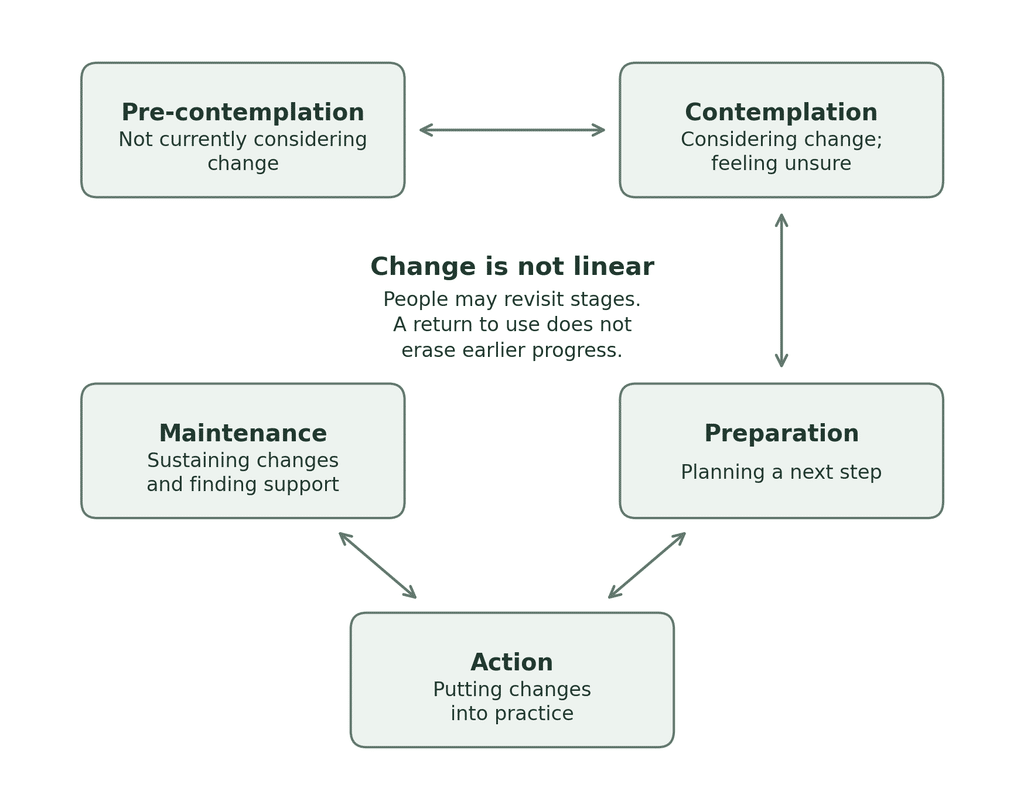
Figure 1. Original illustration based on the stages-of-change model described in SAMHSA TIP 35 (2019).[4] Arrows show possible movement between neighbouring stages, not every possible route. Relapse is not shown as a required stage.
What are we helping someone build
As professionals, friends or family members, we can be ready for action before the person we are supporting is ready themselves. We can see the harm and desperately want things to improve. They may also see that harm, while fearing what life will feel like without the relief that using provides.
Someone can want change and still feel frightened of changing. If alcohol or drugs have helped them endure painful experiences, what are we helping them build as an alternative? Do they have access to treatment, practical support, safe relationships and somewhere to turn when distress becomes overwhelming?
A coping strategy suggested in an appointment is only useful if someone can draw on it when they need it. Recovery may also require medication, help with housing, or treatment for coexisting mental health difficulties. It cannot rest on willpower alone.[2,5]
People need opportunities to find their own reasons for change and have a meaningful say in their goals. Supporting that process means continuing to engage, exploring what matters and reducing harm while working towards the next achievable step.[5]
The limbo between services
One of the hardest things I have witnessed as a mental health nurse working across services is the limbo people can find themselves in when they experience both mental health difficulties and addiction. They may be asking for help, yet struggling to find a service able to respond to the whole picture.
There are clinical challenges. Intoxication can complicate assessment, and the timing of particular interventions needs careful consideration. But difficulty completing an assessment does not remove someone’s need for care. NICE is explicit that people with coexisting severe mental illness and substance misuse should not be excluded from mental health or substance misuse services because of the other condition, including when they present intoxicated.[6]
Trauma is not always something that happened before addiction. People may experience further abuse, exploitation, violence and loss while using. Dependence, financial pressure and unsafe circumstances can leave someone with fewer options. Being intoxicated never makes them responsible for another person’s decision to abuse or exploit them.
In my work, I have seen how further harm can add to distress, shame and isolation. For some people, it becomes difficult to imagine who they are beyond their trauma, substance use or mental health difficulties. Part of our work is continuing to recognise their interests, relationships, strengths and hopes, even when they struggle to see those things themselves.
Supporting people and their relationships
There is pain for families and partners too. When someone returns to using, it can feel as though alcohol or drugs have been chosen over the relationship. Understanding addiction does not make that hurt disappear. Compassion for the person using must leave room for the wellbeing, safety and boundaries of those around them. Nobody is obliged to remain in an unsafe relationship.
Support matters when life appears to be going well, too. Marriage, becoming a parent or starting a job can bring joy alongside unfamiliar responsibilities, disrupted routines and pressure. These events do not automatically mean someone will relapse. They are opportunities to ask how the person is coping and whether their support needs to change. UK guidance emphasises continued recovery support and preparation around transitions.[5]
Making it safer to ask for help
Asking for help can be one of the hardest parts of recovery. For someone with a history of trauma, speaking about their difficulties may feel exposing. If previous attempts have met with judgement, punitive responses or another referral elsewhere, trying again can take considerable courage.
Trauma-informed practice emphasises safety, trust, choice, collaboration, empowerment and cultural consideration.[7] In practice, I believe that begins with curiosity about what someone is experiencing and what might help. It does not require them to disclose everything that has happened to them. They may not want to share, may struggle to find the words, or may not understand the connections themselves.
We can recognise strengths that are easy to overlook: asking for help, returning after a setback, maintaining a relationship or continuing to show up when life feels overwhelming. Agency means having a meaningful say in what happens next, with clear information about the options available.
That responsibility extends beyond drug and alcohol services. Workplaces, education, social care and family networks can influence whether someone feels able to seek help. Their roles differ, but each can offer respectful responses, appropriate boundaries and routes to specialist support. Family and workplace support should complement accessible treatment, rather than be expected to replace it.
For me, hope lies in helping someone see possibilities beyond how they are coping today, and ensuring they have a voice, practical support and people alongside them as they work towards those possibilities.
References
[1] Dube, S. R., Felitti, V. J., Dong, M., Chapman, D. P., Giles, W. H. and Anda, R. F. (2003). Childhood abuse, neglect, and household dysfunction and the risk of illicit drug use: the adverse childhood experiences study. Pediatrics, 111(3), 564–572. Read source
[2] National Institute of Mental Health (reviewed 2025). Finding Help for Co-Occurring Substance Use and Mental Disorders. Read source
[3] Prochaska, J. O. and DiClemente, C. C. (1983). Stages and processes of self-change of smoking: toward an integrative model of change. Journal of Consulting and Clinical Psychology, 51(3), 390–395. Read source
[4] Substance Abuse and Mental Health Services Administration (2019). Enhancing Motivation for Change in Substance Use Disorder Treatment. Treatment Improvement Protocol 35, especially chapters 1 and 7. Read source
[5] Department of Health and Social Care (2025, updated 2026). Clinical guidelines for alcohol treatment. Chapters 4, 5 and 6 cover shared goals, psychosocial interventions and recovery support. Read source
[6] National Institute for Health and Care Excellence (2019). Coexisting severe mental illness and substance misuse. Quality standard QS188, quality statement 2: Exclusion from services. Read source
[7] Office for Health Improvement and Disparities (2022). Working definition of trauma-informed practice. Read source
[8] NHS (accessed 5 November 2026). Alcohol-use disorder. Safety information on withdrawal and access to treatment. Read source
Web references and support details checked on 5 November 2026. The stages-of-change illustration is newly drawn for this article; it does not reproduce a third-party graphic.
National support and routes to help
You can ask for support even if you are unsure about stopping. A GP or local drug and alcohol service can help you explore treatment. The organisations below offer different forms of information, treatment access or peer support; they are not interchangeable, and local eligibility varies.
Alcohol withdrawal safety
If you may be physically dependent on alcohol, seek medical advice before stopping or cutting down suddenly. Withdrawal can be dangerous. Call 999 for severe withdrawal symptoms such as seizures, hallucinations or confusion, or another medical emergency.[8]
Advice if you are concerned about your own or someone else’s drinking. 0300 123 1110; weekdays 9am–8pm, weekends 11am–4pm.
Confidential drug information and advice. 0300 123 6600, available 24 hours a day, seven days a week. Text 82111; standard call or text charges may apply.
Recovery meetings online and in person, with a separate Family and Friends programme.
Alcoholics Anonymous Great Britain
Peer support for people who want to stop drinking. Meetings online and in person. Helpline 0800 917 7650.
Peer support for people seeking recovery from drug addiction. Meeting information and helpline 0300 999 1212.
Drug, alcohol and mental health services across England and Scotland, plus free confidential online advice. Check the website for local services and current webchat availability.
Support for families and across the UK
Information and signposting for families affected by someone else’s drug or alcohol use. Some direct services have geographical eligibility criteria.
Al-Anon Family Groups UK and Eire
Support for people affected by someone else’s drinking. UK helpline 0800 0086 811; meetings and information online.
Support for children and adults affected by a parent’s drinking. Free confidential helpline 0800 358 3456; email helpline@nacoa.org.uk.
Free bilingual drug and alcohol advice for individuals, families and carers in Wales. 0808 808 2234, available 24 hours a day, seven days a week.
Information about alcohol support and routes to Scottish services, including support for families.
Northern Ireland Public Health Agency information and directory of local treatment and family support services.
Details checked on 5 November 2026. Opening times, eligibility and availability can change; check the organisation’s website for current information. Peer support is an option alongside professional care and is not a substitute for medically supported withdrawal.
Disclaimer: The views expressed in this opinion piece are those of the author and do not necessarily reflect the views of The Well Crowd. This content is for information and discussion purposes only and should not be taken as medical, health, or professional advice.
Related News
-
 Industry News
Occupational Health, Safety & Prevention
National funding secured to tackle health-related absence in the workplace
20 January 2026 3 min readAll Sectors -
 Industry News
Mental Health & Emotional Wellbeing
Teacher Wellbeing – The Most Important Piece in Education’s Puzzle
14 November 2025 4 min readEducation -
 Industry News
Mental Health & Emotional Wellbeing
Workplace silence putting UK wellbeing and productivity at risk, MHFA England warns
10 February 2026 3 min readAll Sectors -
 Industry News
Mental Health & Emotional Wellbeing
Architect burnout nearly twice UK average, raising early career retention concerns
27 March 2026 3 min readMedia & Creative